Biodegradable film with integrated sensors aims to reduce microplastics in European Agriculture
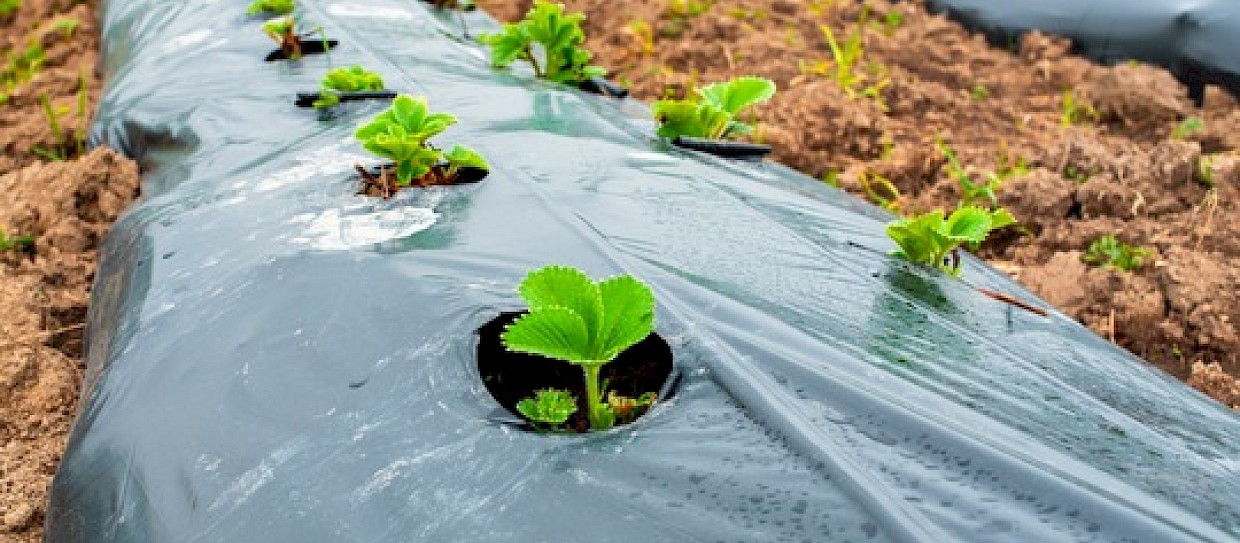
A new EU project is developing a biodegradable smart agricultural film that gives berry growers soil health data to optimize their crops.
Every year, conventional agricultural film leaves large amounts of microplastics in the soil. Now, a new European research project focused on berry production aims to develop a biodegradable film that not only breaks down naturally after use but is also equipped with printed sensors that provide berry producers with valuable knowledge about their crops. Danish Technological Institute (DTI) contributes with expertise in printed electronics and will also develop environmentally friendly inks to print the sensors that can be integrated directly onto the biodegradable film.
 The film must be able to last for an entire growing season and then degrade quickly and naturally in the soil. The project strives to develop a solution that can improve crop yields through better monitoring and reduce the amount of microplastics in the soil. Archive photo: Adobe Stock.
From a plastic problem to a biodegradable solution
Agricultural films are widely used in European berry production to protect crops and create the right microclimate. Traditional films do not degrade, and when fields are ploughed after harvest, plastic residues are mixed into the soil, creating a growing problem of microplastic pollution.
The ECOSYSTEM project represents a circular approach in which waste from berry production is transformed into valuable raw materials in the form of polymers that can be used for biodegradable film. The film must be able to last for an entire growing season and then degrade quickly and naturally in the soil.
- There is enormous potential in developing an intelligent film that can provide berry producers with data on soil moisture and temperature, while also degrading naturally. Previous research shows that mulch films can alter soil temperature and moisture beneath the film, affecting both plant growth and soil life. This makes the under-film environment an important target for sensing and monitoring, says Sol Gutiérrez Alvarez, specialist in printed electronics at Danish Technological Institute.
The project aims to develop a solution that can eventually reduce agriculture's waste management costs, improve yields through better monitoring, and reduce microplastic pollution in agricultural soil.
Printed electronics with environmentally friendly ink
In the project, DTI will develop and test sensors that can be printed onto the biodegradable film. The most important task here is to develop printable inks that are both functional and environmentally friendly. In this context, DTI will test copper-based ink, which the Institute has developed in other projects, and which has a lower CO2 footprint compared to silver inks. The main challenge in ECOSYSTEM will be to adapt the inks so that it can degrade safely together with the film.
- Printed electronics have the advantage that we use very small amounts of conductive materials. This helps keep the material footprint low. At the same time, the environmental and safety aspects of the developed solutions will also be assessed within the consortium, including through life-cycle assessment work, explains Sol Gutiérrez Alvarez.
About the ECOSYSTEM project
ECOSYSTEM is a European research project with nine partners from five countries. The project is supported under the Horizon Europe programme and has a duration of 4 years and a total budget of 3.9 million euros. The project aims to develop biodegradable polymers and active materials for both packaging and agriculture based on circular, bio-based value chains.
Learn more: https://www.ecosystem-he.eu/